This project examines how writing changed over the course of the nineteenth century.
During the early modern period, writing—and intellectual work more broadly—was routinely framed as combinatorial, and books were frequently written by compiling and editing parts of other works, often without attribution. Over the eighteenth and early nineteenth centuries, however, a new epistemology of labour displaced that framework. Authors were recast as autonomous creators of intellectual property, inspired by “genius,” that required legal protection. Combinatorial labour was demoted to “mechanical” status. As Lorraine Daston has put it, it was framed as “mental, but not intelligent.” Working amid and in the wake of this shift, nineteenth-century writers, scriveners, publishers, compositors, and printers navigated a world in which what constituted a “copy” and what constituted a “new work” was increasingly consequential, with implications for everything from a work’s function as a form of capital to what a compositor could charge to set it. At the same time, changing laws and technologies made defining these categories increasingly difficult.
Funded by a SSHRC Insight Grant (2025-2030), Manufacuring Literature investigates how—and how fast—the ways book-text was created changed in this context. More broadly, it examines what the labour of textual production looked like, how that changed over time, how authors and other book-trade workers negotiated changing laws and ideas about what writing should look like, and the extent to which genre shaped their decisions (e.g. how is making a novel different from making a medical book?). An article published in Book History in 2023 outlines some findings from my earlier work on this history. The project I am now working on uses several different methods to address questions raised in the article. Computational text analysis using large corpora of digitized historical texts from the Hathi Trust Digital Library and the UK Medical Heritage Library is allowing me to identify, classify, and model text reuse. Archival research focused on the creation and reception of a sample of the works studied computationally will help me better understand the labour practices involved in creating these texts, how book-trade workers understood them, and how they negotiated evolving laws and ideas about writing over time.

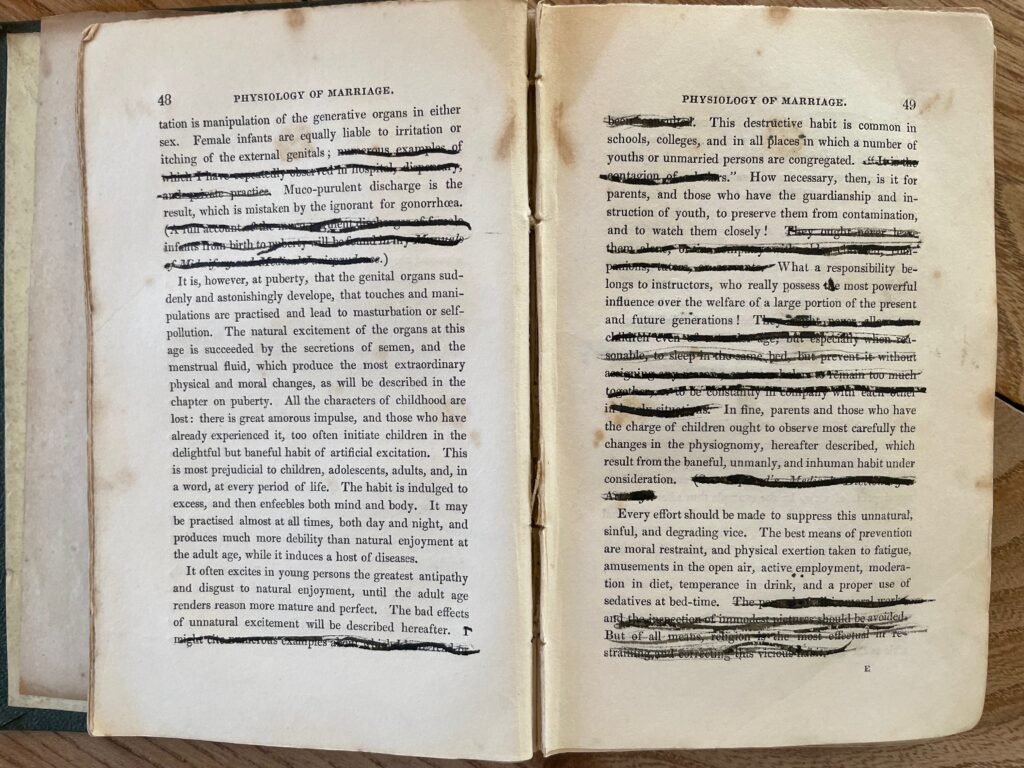
An invitation to speak at the University of Toronto’s Book History and Print Culture Graduate Student Colloquium in March pushed me to try to reenact practices that I thought were involved in making some of these books through an attempt to physically transform a copy of the obstetrician Michael Ryan’s The Philosophy of Marriage in Its Social, Physical, and Moral Relations (London: John Churchill, 1837), pictured here, into the popular pamphlet/contraception manual Marriage, Historically, Philosophically, Legally, Physiologically, and Pathologically Examined (London: H. Smith [William Dugdale], c. 1841), attributed to “Henry Horne, M.D.” The latter is essentially a radical abridgement of Ryan’s book combined with a final chapter mash-up of excerpts from the physician Robert Dale Owen’s contraception pamphlet Moral Physiology: Or, a Brief and Plain Treatise on the Population Question (1831) and the radical printer Richard Carlile’s contraception pamphlet Every Woman’s Book; or, What is Love? (1826).
Findings from my analysis of the text suggested to me that that Horne’s Marriage was likely created by marking up a copy of Ryan’s book and getting a compositor to set the edited text, and then “new” copy, created by mixing copied down excerpts from Owen and and Carlile’s books with the author’s own comments, at the end. I used historical materials—a copy of the 1837 edition of Ryan’s book, iron gall ink that I made with my students last fall, a quill pen (though a steel nib pen might be more accurate for 1840)—to try to reenact the process. Halfway through marking up the text, I realized that I had no idea whether some standardized editorial method (nineteenth-century mark up language?) would have been used, and my questions proliferated from there! The experiment was really productive for me in that helped me see what I don’t know, and what I need to learn, to do this project right. I’m hoping to incorporate a series of materially focused research-creation experiments along these lines into the project to complement the computational and archival research components.